
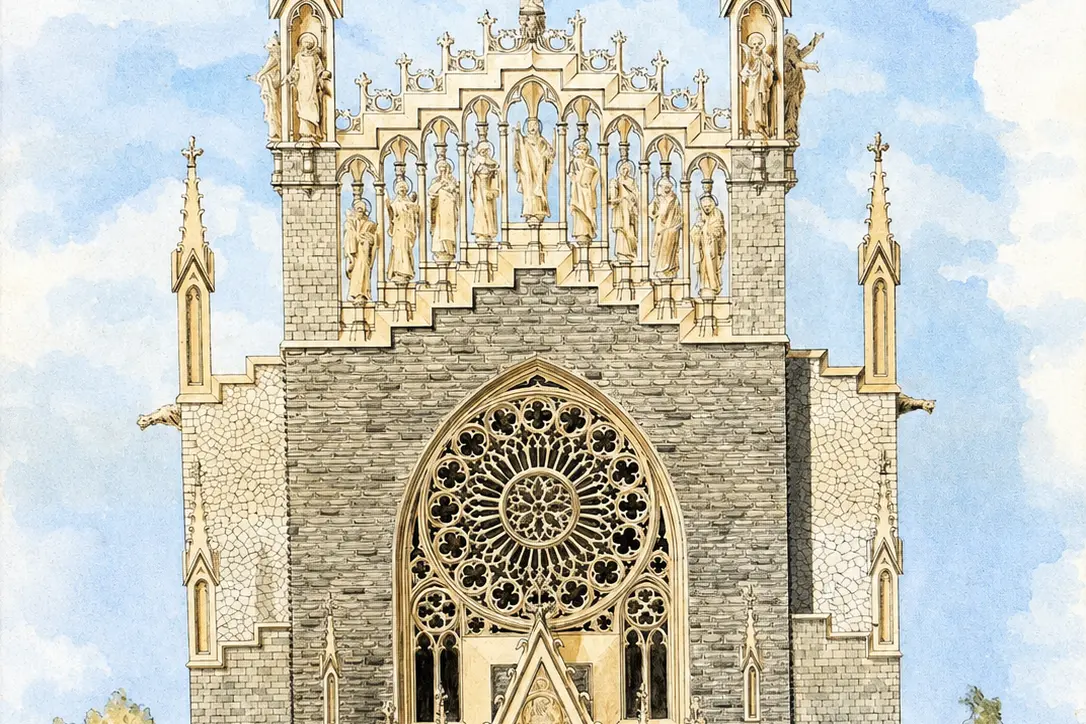
Tradition tells us that the Apostle Bartholomew was martyred for refusing to renounce his beliefs; as punishment, he was flayed alive. For centuries, artists depicted him carrying the attributes of his martyrdom: a knife in one hand and pieces of his own skin in the other. In the Sistine Chapel, Michelangelo painted him bearded and vigorous, seated upon a cloud: in one hand he holds a humble knife, while from the other hangs the entirety of his flayed skin; upon that vast, empty and distorted hide, the artist chose to paint his own face.
This play of mirrors between the artist and his work was not discovered until many centuries later. It was the nineteenth century, and in Rome Michelangelo’s self-portrait was discovered hidden in the skin of Saint Bartholomew. It was the nineteenth century, and in this small Mediterranean valley a plague struck many of Sóller’s orange trees. Hardship drove many sollerics to seek their fortunes far from home: they sailed across seas and oceans, learned to cultivate coffee and cocoa, and ran grocery stores and maisons. That apparent misfortune —since we are speaking of saints, why not call it divine punishment— ultimately became the driving force behind a social, cultural and architectural revolution that would forever transform the appearance of the valley. A community of farmers and artisans also became a community of emigrants, merchants and entrepreneurs; a people who learned to leave and, above all, to return.
The associations we construct between images and stories may be capricious, but they are never in vain. Nothing connects the flayed body of an apostle painted in sixteenth-century Rome with the modern history of Sóller. Or perhaps it does. Placing one image beside another allows us to discover unexpected correspondences and to look again at what we thought we already knew. Perhaps that is why we continue to tell old stories and repeat names from the past: not only to remember what happened, but to continue thinking about ourselves through them.
It is remarkable that, almost two thousand years later, saints, apostles and martyrs should still be the guardians of the days we feel most deeply to be our own. They give a name and a place in time to something that is, in truth, far broader and more elusive: everything a community has been, everything it is and, perhaps, everything it may yet become.
And so, for Saint Bartholomew, apostle of the skin and patron saint of those trades that worked it, we also celebrate the paths and fountains that ancient civilisations brought forth in this valley; the citrus fertility of these lands and the promise drawn by the sea in such a perfectly rounded bay. We celebrate ancient and epic victories against pirates and corsairs. We claim ourselves as that Valley of the Hesperides that Robert Graves once sought to recognise among our mountains. We remember the generations who crossed oceans and returned carrying palms from distant shores, Modernist reveries, cinematographs and trains that have never stopped running. We also honour the working-class memory of the many women weavers who, among looms and factories, sustained the life of an entire town for decades; and all the hands that have worked this valley and made it habitable.
For Saint Bartholomew, we celebrate all of this. We celebrate those who were here before us, those of us who are here today, and those who will come after. We celebrate a people who have learned, century after century, to admire the mountains and revere the sea, to leave and to return, to transform themselves without ceasing to recognise who they are.
Today, from Can Prunera, we celebrate Sóller.
Happy Sant Bartomeu!