
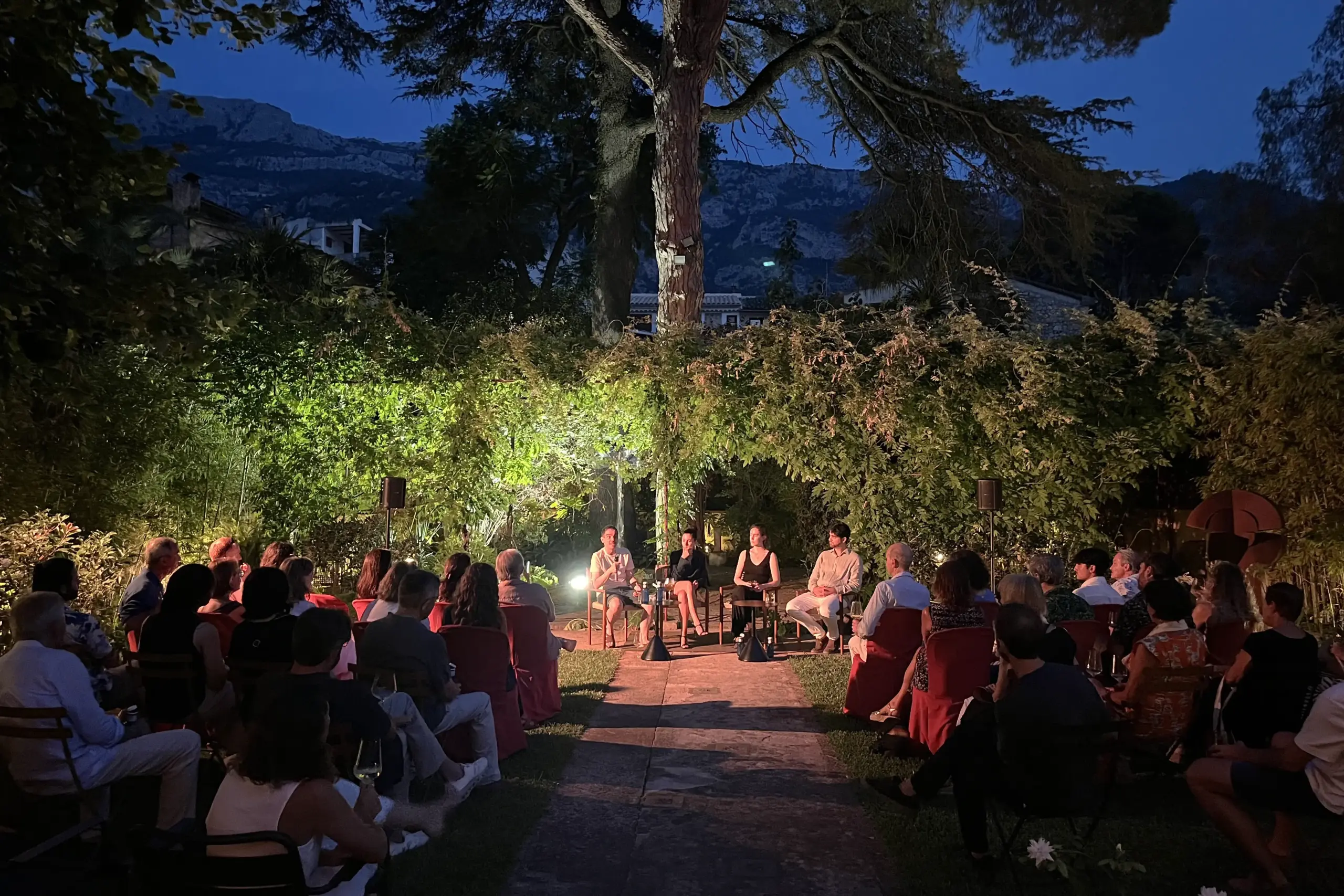
Alberto Conejero, Natalia Huarte, Lucía Pérez Dezcallar, and Magí Garcías transformed words into flesh. They turned words into poetry and songs. August 1, 2026, will go down in Can Prunera’s history as the day Leonora Carrington came back to life thanks to a radically human alchemy of word, body, and music. And it was no easy task to carry out this metamorphosis of the soul.
The site-specific version of Leonora (2024)—whose original text was published by Pepitas ed—adapts Alberto Conejero’s text: our very own “Aeschylus of Vilches”—for the Modernist house of Can Prunera. Thirty-eight fortunate individuals had the immense pleasure of being part of something extraordinary. For nearly an hour and a half, we were able to wander together through the halls, corridors, and rooms of this Art Nouveau home to invoke the indomitable spirit of the painter Leonora Carrington, masterfully portrayed by Natalia Huarte. This staged poem is a free interpretation of the universe of the celebrated surrealist artist, sculptor, and writer whose resonance still permeates our hearts.
Like all literary and dramatic journeys, it involves a dream, preparation for the journey ahead, and a constant adaptation to the dangers and setbacks that may arise along the way. This beautiful and heart-wrenching Odyssey takes us to the beginnings of Leonora’s artistic journey, her encounter with Max Ernst—the most beautiful face of Surrealism—her flight from France due to the Nazi occupation, and her experiences in postwar Spain until her escape from Europe. Against this immersive historical backdrop, we could feel as if the body’s chrysalis were opening before us, allowing us to witness and take part in this love letter to resistance, rebellion, and desire in times of darkness.
As actress Huarte told us during the post-performance discussion, Leonora doesn’t feel sorry for herself; she doesn’t play the victim. She uses the mortar of defeat and suffering to create, seek, and love without hindrance, in an indomitable way. She is true to herself at all times. The admiration we all felt for Natalia was shared because she lifted us up, made us cry, laugh, and dance, but never made us feel pity for the painter, because everything brought her closer to her final revelation. “Revelare,” in its original Latin sense, meant to remove the cloth that concealed something, to reveal a secret or a mystery, to make known that which was unknown. By unveiling and baring herself, Natalia-Leonora, the centaur-woman, made us participants in the universal human spirit. “I am multitudes,” says Huarte-Leonora; “my self-portrait is always collective.” We are part of it forever.
This elevation was also possible thanks to Magí Garcías, an exquisite composer, and the promising young artist Lucía Pérez Dezcallar, armed with her cello to captivate us with her music. It was the first time she had played for a play, and she mastered the tempos, waltzes, and fados required by the performance. She did not falter; she rose to greatness, becoming immense and solemn, helping Leonora spread her wings for her final flight.
Alberto Conejero, who carries the Greek Classics within his soul, has created an ineffable, primal, and universal text. He has managed to channel pain without making us feel pity for it; only a hope that intoxicates, elevates, and captivates. The works of Euripides, Sophocles, Calderón de la Barca, and Angélica Liddell flow through the veins of this creator from Jaén. His soul is ancient, and as he reminded us: we are radically human, and we must ride on the wings of imagination to continue healing the wounds we carry within.
To quote Silvina Ocampo: Why invent anything? The truth is stranger. The lives of the men and women of the world—both those that seem anonymous and those carved in the marble of time—need human beings capable of daring to remember without condescension. True creators like Alberto Conejero who tell us, looking us in the eye: Create what would not exist without you.
That is what we will continue to do, Natalia, Alberto, Lucía, and Magí.
Your heartbeats serve to usher in new worlds.
Now we are heading together toward the shores of the future.