
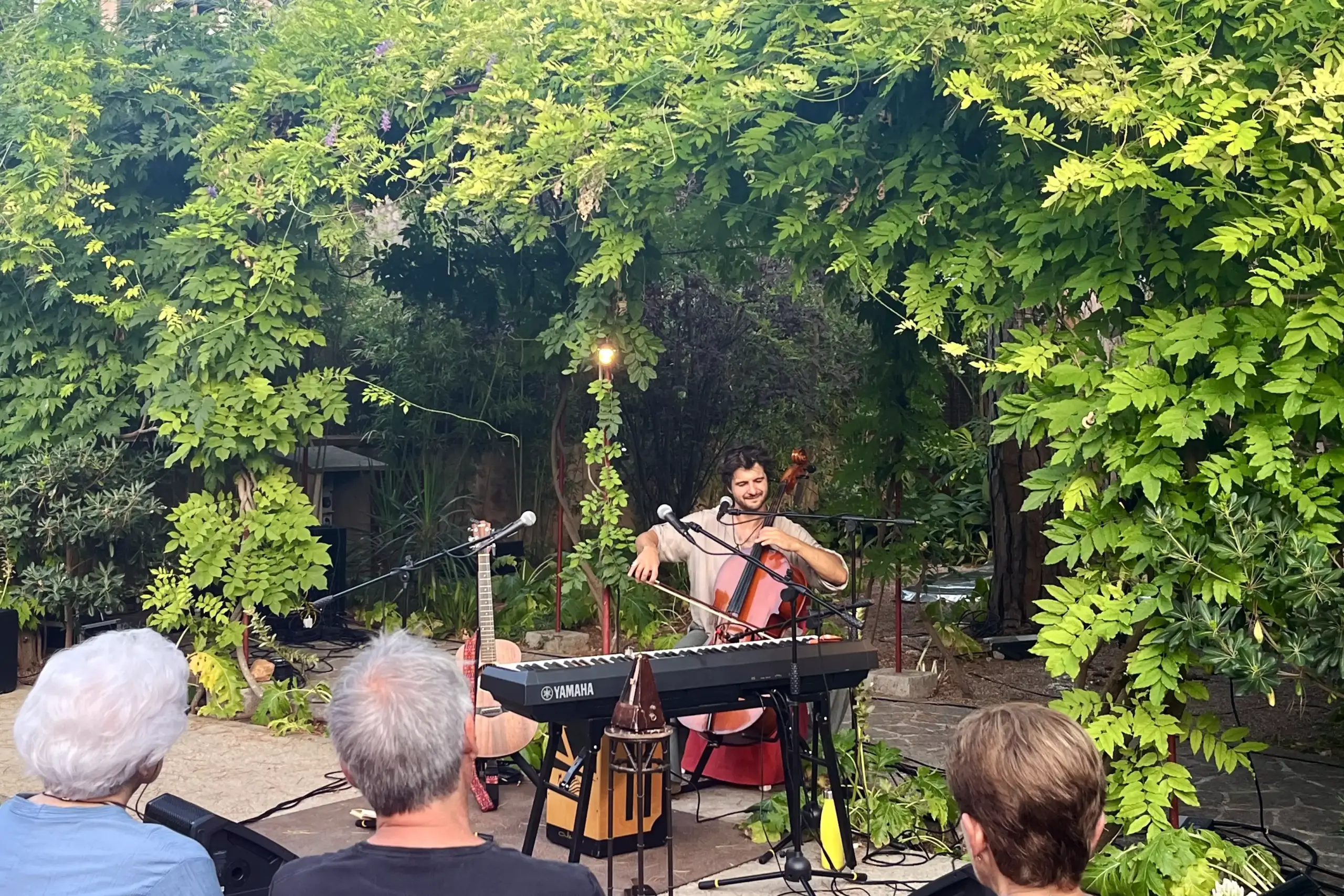
When the virtuoso Joan Vila made his entrance into the sculpture garden at Can Prunera, no one could have guessed what was about to happen. I don’t think even the musician himself – winner of the Ciutat de Palma Prize – knew what he was about to awaken in us. Surrounded by a cello, a guitar, a flamenco box, a piano and a subtle metronome, he began his unique jazz polyphony. His poetic audacity, innate ease and Mediterranean self-assurance were palpable from the very first chord. We were in the fractal grip of Mon Joan Tiquat’s world, and none of us present wanted to miss a moment of it. Joan Vila wanted to play, and we wanted to play along with him.
Like the Hatter in Lewis Carroll’s timeless work, Alice in Wonderland, Mon Joan pulled a fresh, resonant and unusual repertoire out of his hat to make us laugh and sing: two words that bring instant joy and are not always easy to experience. And so the symphony began with one of his classics, ‘Adaptació al medi’, from his album Es temps i sa llavor (2021). Here he ensnared us in his web, woven with the elegance of well-crafted words and the subtle irony of one who knows his craft inside out.
Dancing between Puigs Majors and Puigs Menors, we gradually forged a beautiful Mallorcan camaraderie, into which the messages of the purest protest songs were woven in a subtle and sly manner. It was at that very moment that Vila treated us to those eccentric touches that make him unique. With his usual mastery, he managed to transition from a simple song with just guitar and vocals to a sort of piano tarantella, accompanied by his raspy voice and… a party whistle. Yes, you read that right: a party whistle. A purely festive contraption that serves exactly the purpose its name suggests, but for Mon Joan it can act as his backing trumpeter to create a track that had the whole audience in stitches. He’s the Mallorcan Jamie Cullum. There’s no doubt about it.
And here comes another twist in the script. Like the branches of an ancient pine tree reaching for the sun without even realising it, Joan Vila’s mischievous fingers reached out towards the cello. This instrument holds within it both lament and grace. Nostalgia, melancholy and joy dwell within the cello’s strings, separated only by the delicacy of the one who knows how to caress them. The atmosphere was imbued with voices, physicality and sonic richness. The musician has sown part of his soul into this instrument.
As life is capricious, unpredictable and utterly mad, the cicadas also decided to join in the festivities with young Vila. With his wooden flamenco boz, as if he were a member of Ketama, he began to strike and beat that noble box with feeling, taking us back to our primordial, fiery origins in primitive songs. When this track ended, it gave us pause for thought, because his music also has clear philosophical undertones.
He told us that, in his view of creation, he doesn’t know whether he’s talking about music or life; that it’s worth creating to establish a counterpoint to hold on to when times get tough; and that if, in the end, everything is digital, artificial and sterile… who will dare to tell the stories that are truly worth telling?
During the final bars of the concert, Mon Joan taught us a few notes so we could all sing along at the top of our voices. What we didn’t know was that he would leave us singing his song, only to then leave the stage to the rhythm of his own music. A subtle touch that left us all speechless, on our feet and applauding.
This is the world of Mon Joan Tiquat. We simply live in it.