
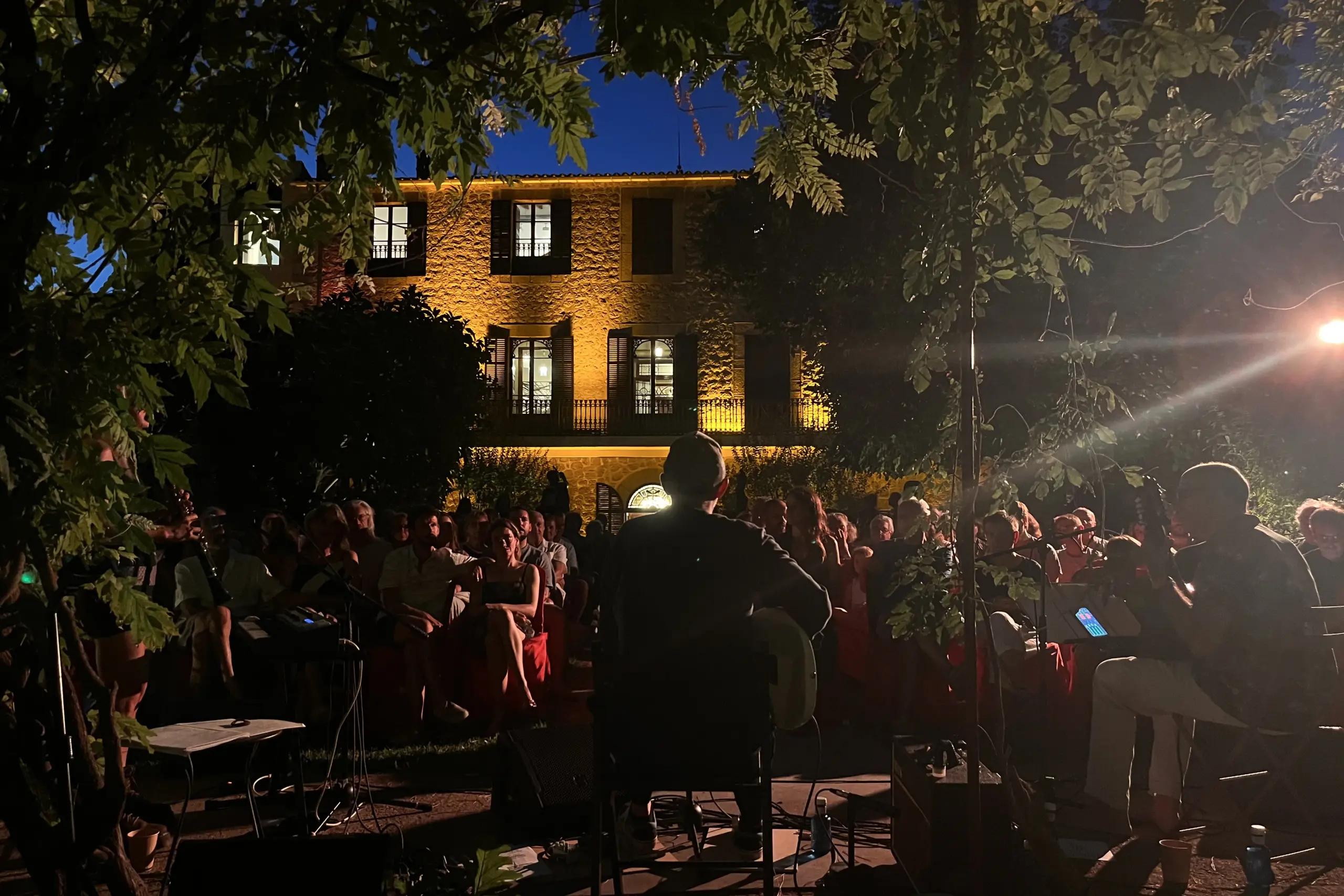
A chronicle of a concert during an August sunset at Can Prunera
CENTO. From the Latin cento, -ōnis: a piece of cloth made from many patches.
A cento is a literary composition constructed from words, phrases or lines borrowed from one or more works. Like patches in a piece of cloth, these fragments are torn from the place where they belonged and sewn together anew.
The first centos were written —as always— by the Greeks; they were assembled from lines by Homer. Latin authors preferred the ones by Virgil. Over the course of the twentieth century, this ancient technique of unstitching and restitching words reappeared under new names and in new forms: in T. S. Eliot’s collage of voices and quotations; in Walter Benjamin’s montages; in the cut-ups of Brion Gysin and William S. Burroughs; or in Borges’s imagined Pierre Menard, capable of rewriting, word for word, the very same Don Quixote and nevertheless turning it into a different work.
All these practices share the same suspicion: originality is a farce. Eugeni d’Ors put it this way: “Everything that is not tradition is plagiarism.” And Picasso is said to have declared: “Good artists copy; great artists steal,” although perhaps this quotation is itself a cento. We, who love tradition and admire the practice of hacking, do not claim to be either geniuses or good artists, but merely to honour them and tell you everything that happens (and does not happen) at Can Prunera. We believe that, after Joan Miquel Oliver’s concert, it seemed neither possible nor necessary to add much to what we had just heard.
The chronicle that follows is a cento composed entirely of words sung and heard on the night of 29 August in the garden at Can Prunera.
Not a single word is new.
It never is.
The order is.
_
Carregam es cotxes, encenem motors,
agafam carretera a la fi del món.
Però això és Mallorca, aviat arribarem:
es tramvia a sa plaça,
ses taronges,
el cel d’agost.
Hi havia una porta,
un semicercle de quatre colors, un vidre damunt,
un safareig en es jardí amb peixos taronges.
I es verds:
llimoneres, alzines, pins,
alguna palmera, algun eucaliptus.
Ja no donam a basto
de tanta gent que mola un munt.
Avui anam de còctels.
Què voleu:
polo de llimona o polo de menta?
Jo afinava sa guitarra.
Atlantis fa llum.
Atlantis, callau!
Jo te don tots es meus watts.
El cel net i uniforme,
res no el tapa i res no li fa ombra.
Sol cruixent a s’exterior.
Lenta, càlida i benigna
és sa claror des sol.
Afín sa mirada.
Per mirar tenia uns ulls
i mirava passar els ovnis.
Decant sa mirada,
mir enfora i cerc on són es punts de fuga,
on apunten ses arestes
i on acaben es carrers.
Veig un lloc a on el món s’acaba,
poblets molt de lluny,
horitzons apoteòsics.
Colors lluminosos, aquelles pintures
són ara muntanyes,
torrents espitosos.
Sa llum lateral de s’horabaixa.
Cel ponent posant colors.
Treus es cap i me dius
que hi ha molts de peixos.
Ell va dir planetes,
ella va dir «quins?».
Registre de peixos, comerç, migracions.
De color taronja és també aquest peix.
Se pon es sol.
No ho saben ses persones
si és un dia més o és un dia manco.
Sa velocitat de sa llum
no canvia dins s’espai en moviment,
i a s’equació sa variable que varia
és sa des temps.
Un avió de tant en tant mos fa un eclipse,
és un antiflaix,
un lapse molt escàs de temps.
Però un dia sa cosa va canviar.
Sa nit ocultava els avions
i sa lluna amb paraigües
al cel despenjava neons.
Sa lluna plena vetlla es tarongers.
Veig es cràters de sa lluna
i es avencs que se dibuixen
a sa llum de lluna blanca.
Se desplomen es planetes a galàxies,
allà dalt, no sé on,
i pernocten en silenci ses constel·lacions.
Dins sa fosca lluminosa,
paisatges fluorescents
i cuques de llum.
Estels anònims s’identificaven,
se comunicaven,
se descontrolaven.
I tot és perfecte,
i cantes un tros en directe.
Sentir-se bé de cop i volta
no dura gens,
però no m’importa.