
Santiago Auserón and Nerantzi offer an ode to life at Can Prunera
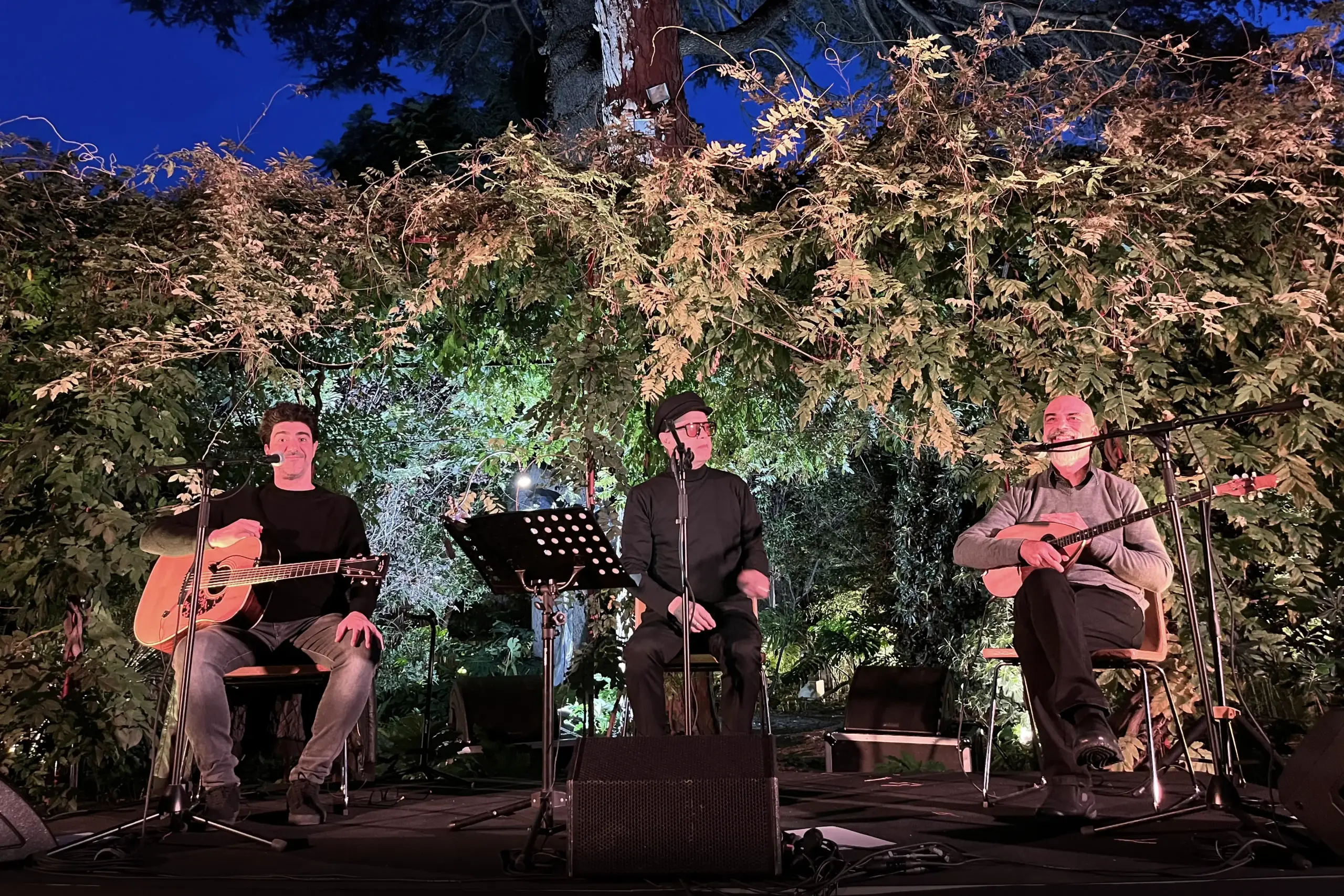
Eros loosens my limbs and makes me tremble; Eros, that sweet and bitter little beast, against whom we can offer no defense. This excerpt from Sappho of Lesbos captures the sweet inevitability of being swept away and ensnared by the intoxication of desire. When passion takes hold—the subtle caress of delight and that wholesome silencing of reason—we surrender to the pure pleasure of the senses, opening the true doors of perception, as Aldous Huxley wrote. Santiago Auserón and Nerantzi were the privileged messengers of the muses, allowing us to enjoy a unique and unrepeatable moment. Auserón, always so cultured and ironic—as if he were a mystagogue—unlocked the channels of music and lyrics alongside his faithful Greek knights, his Ionic and Doric pillars: Theodoros Karellas (guitar and vocals) and Vaggelis Tzeretas (bouzouki and vocals). The transgression of boundaries and soundscapes was the concert’s leitmotif, reviving classic 20th-century songs, gems of popular rebetiko, and Mediterranean ballads, adapted from Spanish to Greek by Auserón himself.
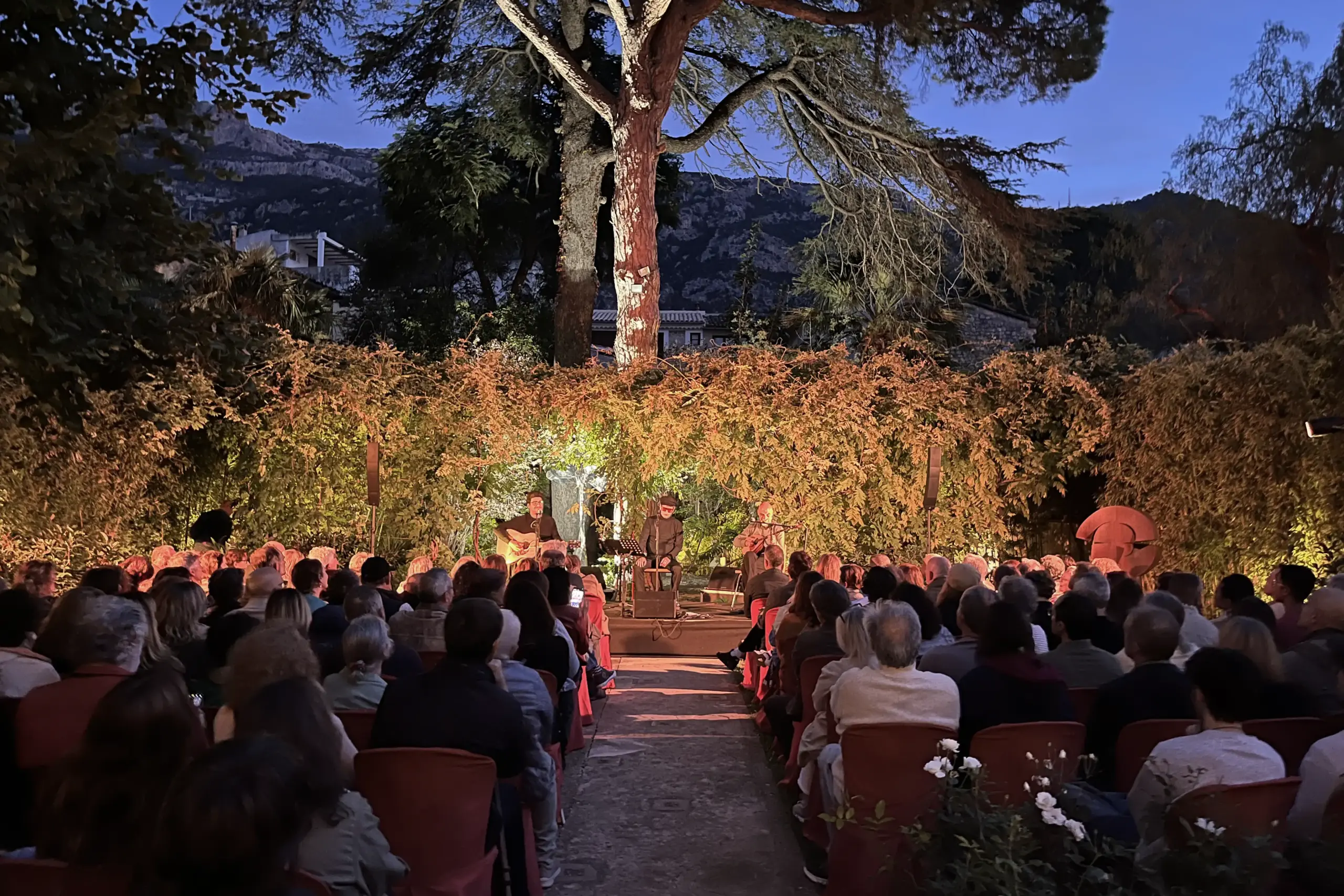
When the first chords sounded and the night began to adorn itself, the sculpture garden once again rose up like a mysterious portal where anything could happen. Auserón expressed it delicately: this journey was necessary; it is a pleasure to inhabit this garden. To inhabit or reside in a space, whether temporarily or eternally, serves to create a kinship, a fraternity of the ephemeral. The links of the great human chain of which we are a part reverberated among the sculptures, with the Slinger of Llorenç Rosselló reminding us with its presence that we too have inhabited ancient times.
You will be my melody, you, my lark in flight, recited Auserón, who had also packed in his traveling suitcase the ancestral tunic of the Homeric poets. The echoes of Hesiod, Aeschylus, Homer, or Kazantzakis himself were very much present throughout the concert. Directly or indirectly, as Pedro Olalla aptly commented, everything we do is Greek. We are Greek without knowing it. In every act, gesture, recited word, food offered, or glass of wine drunk, the Greek soul is present. It is in this full simplicity, in being simple sybarites, that the spirit of Kazantzakis’s Zorba the Greek resides, who writes:
How simple and unassuming happiness is! A glass of wine, a roasted chestnut, a humble brazier… That’s enough!
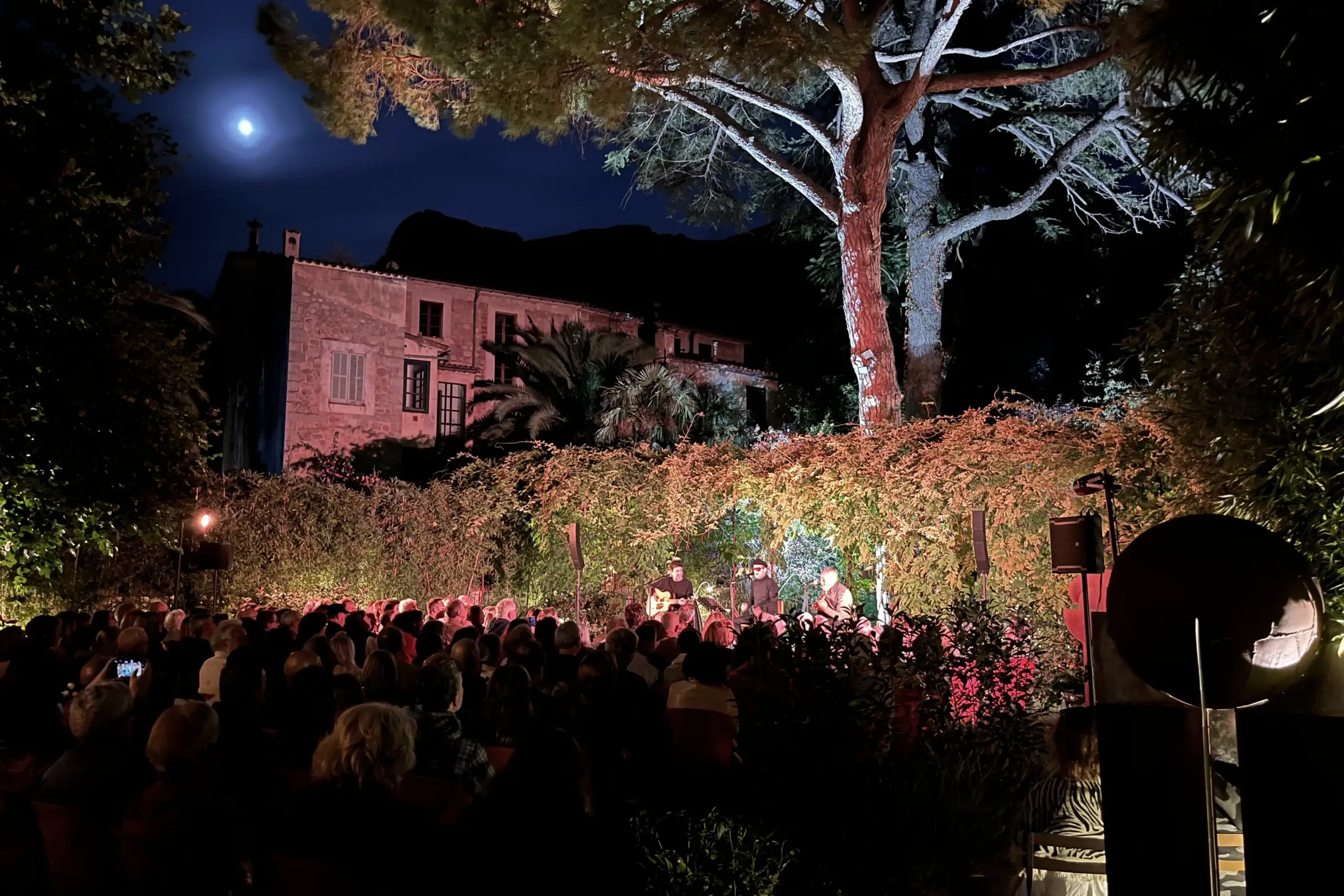
Auserón was the boatman of words. Nerantzi, the gentle breeze that swayed the sails of poetry. The song Tides of Alcohol spurred our devotion to sensual pleasure as the museum’s wine reserves dwindled. A good sign. When the song of the hashish smoker burst in, our bodies already seemed to be rising above the grass, in perfect harmony with the full moon shining in the sky. At one point, Auserón asked us what color our soul was. All of them and none of them, we seemed to reply, because when it comes to the big questions concerning our human condition, sometimes it’s better to answer by dancing.
Old, unrequited desires also hovered over the scene, such as the magnetism exuded by Marilia, the waitress, who for a few moments set Auserón’s soul ablaze, only to quench his lust shortly afterward. In Irenita, too, the alluring touch of the white powder made the wait a delight. Through her words, we were transported to the famous arcades and tea houses of Tiryaki Çarşısı in Istanbul, in the Molla Hüsrev neighborhood, where opium reigned supreme in nineteenth century.
The richness of the song, the melancholic allure of Vaggelis’s bouzouki, and the raspy harmonies of Auserón and Karellas took full hold of us. They made us part of the sweetness of the ephemeral. We fell under the spell of the flower of dreams and once again became those mischievous children running through the port of Piraeus:
This is my haven in a corner of the world,
where happiness can be found in an instant.
And in this haven of my desires,
today they sing for me.
Time ceased to matter, death stopped sharpening its scythe, the blackbirds fine-tuned their trills; amid the sweet bitterness of the oranges, we were able, for an infinite instant, to dance with Eros in the Garden of the Hesperides.