
Let us not, Phaedo, allow ourselves to be overcome by a certain feeling – that of becoming misologists, just as some people become misanthropes; for there is no greater evil one can experience than to abhor dialogues and arguments.
Plato, Phaedo, 89d.
_
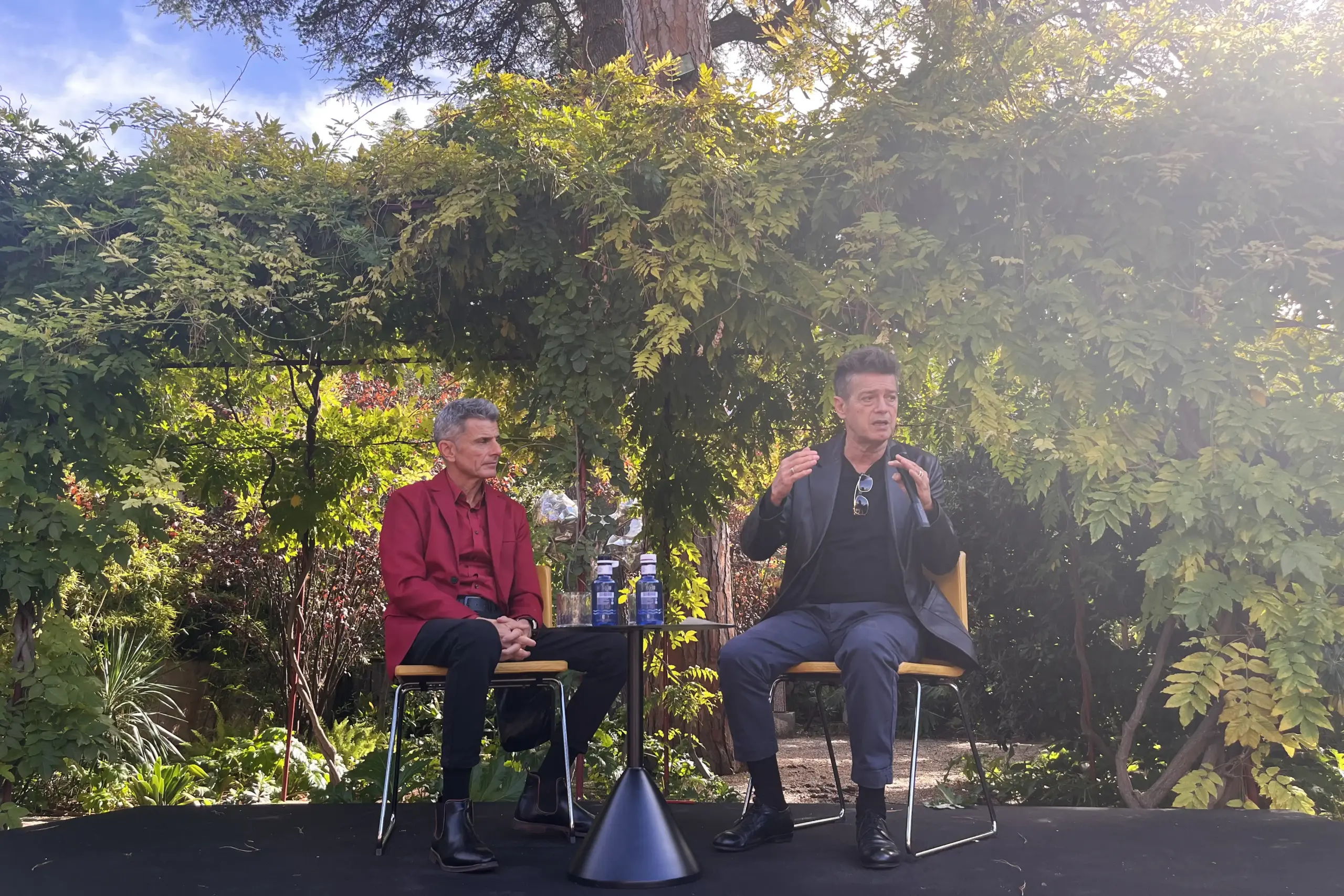
Dialogue is an art in itself. To engage in dialogue is to seek to uncover the symbols hidden behind words. Socrates warns us in this beautiful passage from the Phaedo that we must avoid becoming people who feel aversion or mistrust towards reasoning and intellectual debate. Pedro Olalla and Santiago Auserón have shown us that the love of Socratic conversation remains intact, that respect and admiration for others is possible, and that the greatest act of rebellion today is daring to think as an act of humanist resistance.
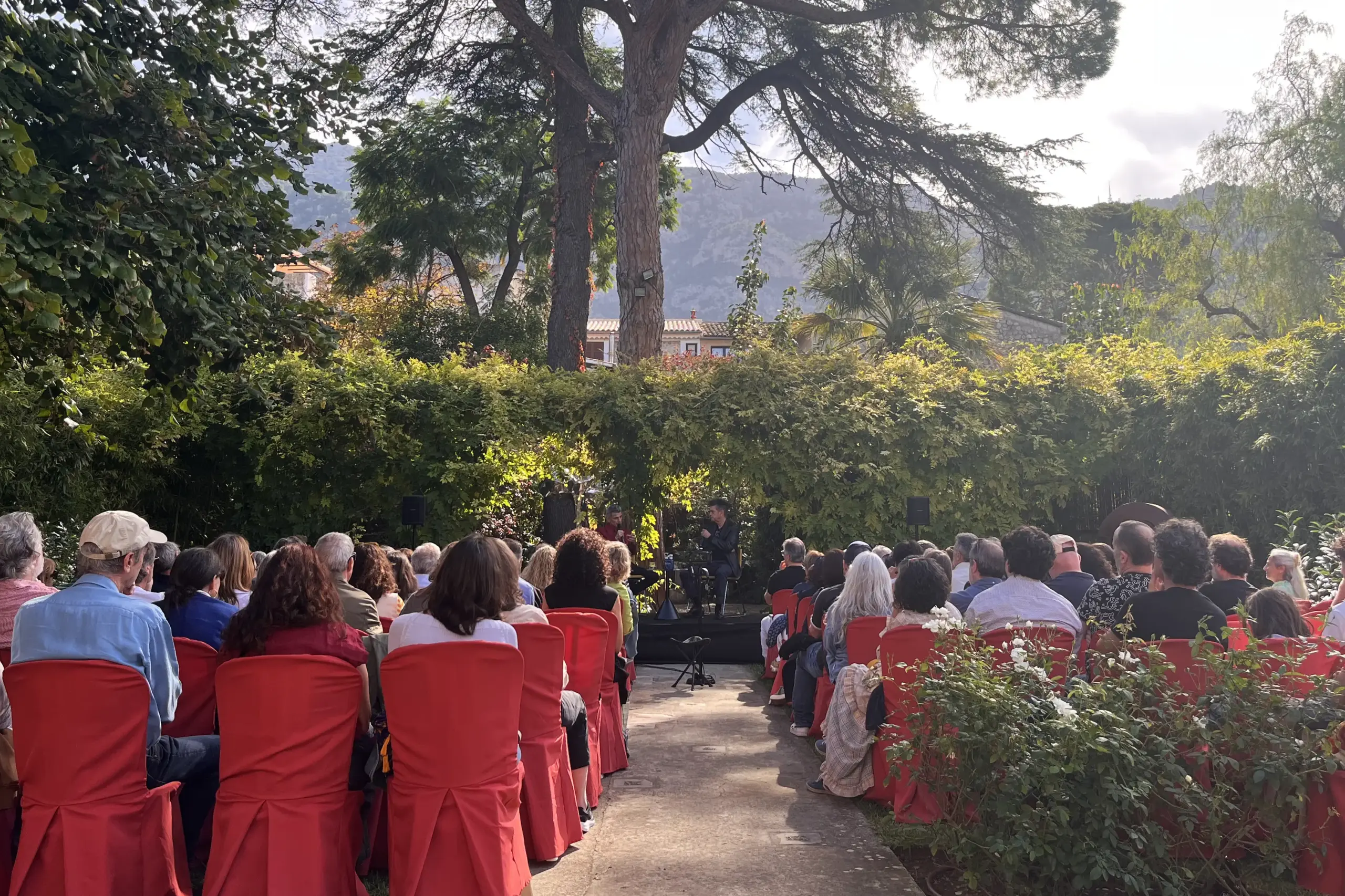
The philosophical symposium took place last Sunday 25th at 12:00, vermouth time. Auserón and Olalla took on the role of symposium hosts, in keeping with the ancient Greek tradition, orchestrating the discussion whilst the attendees enjoyed a glass of wine. The garden at Can Prunera became a locus amoenus, the ideal setting for the logos and its infinite golden threads to unfold. Mousai and logos, music and thought; the art of the Muses and the flow of intelligence, united under the auspices of eternal curiosity. Olalla pointed out to us that the ‘amusos’ were those who did not know or did not wish to know, displaying a disaffection towards paideia. On the other hand, the so-called ‘musos’ were those who did have a cultural interest in society as a whole. A single letter can change the fate of the world.
Auserón and Olalla agreed that there is a philosophical link between music and the word. The echoes of Nerantzi still lingered in the air from the previous evening’s concert, so both thinkers crafted their own unique blend of knowledge, weaving together affinities with captivating eloquence. The density of thought can also envelop spaces and places like mist. A great idea, well-crafted, can become a sanctuary to which one may make a pilgrimage.
Olalla pointed out that one of the great legacies the Greeks have left us consists of two words upon which one can build one’s life: attitude and will. The Greek attitude towards life, in the face of adversity, has that bittersweet quality inherent in the very act of existing. The Greek is aware of their past, and so can foresee misfortune and adapt to it, but never succumb to it. Clarity in difficult times and the will to overcome, come what may, is another great lesson they offer us. It was at this moment that Auserón nodded and added: ‘It is true, my friend, and that is why I believe there are two Greeces: one dreamt of, ideal, and another real, more human.’ The deeply human nature of the Greeks makes them a cheerful and positive civilisation, even when misfortune comes knocking; they are people who pay attention to beauty and understand just how fruitful life’s trials can be in generating new insights. Only a Greek like Theo Angelopoulos could answer in this way the great question of our brief yet extensive time on earth:
How long does tomorrow last?
Eternity and a day.
The Greeks, however, with all their victories, shipwrecks and experiences behind them, warn us of one very important thing: we must not succumb to hubris. Pride, arrogance or insolence must be kept in check. We ‘ephemerals’ – as the Greek gods refer to mankind through the words of Aeschylus and Sophocles – must know our limits and never attempt to cross the boundaries of the natural order of the cosmos.
Harmony and rhythm dwell in tension and release, noted Auserón, drawing a fascinating connection between the rhythmic asymmetries of rebetiko with its nine beats, the intervals between notes, the music of the spheres attributed to Pythagoras, and the use of technique to create a break—a caesura designed to make the music flow. Art, too, must be cut or traversed by technique in order to become song. The Pythagorean scales of music, under the patronage of Urania, the muse of astronomy, make the very rotation of the planets the realisation of a musical octave.
For Olalla, this musical connection has always been linked to the power of the word. He writes in *Palabras del Egeo*: ‘Words, those forgotten titans.’ The intrinsic music of words makes them a poetic ally capable of giving meaning to a life.
‘Restlessness is part of our nature as human beings, but we must seek out the meaning of our lives ourselves,’ Olalla explains. As Heraclitus observed, the word is creation and also has a body, even if it is invisible, and it can wound us, pierce us or save us. Another Greek writer, Theodor Kallifatides, wrote: ‘Words have no bones, but they break them’, continuing in the tradition of Heraclitus. 130 people listened attentively to the words of these two mystagogues. They exercised the power of elevation through thought, and our spirits were healed simply by listening attentively to their wisdom.
The Can Prunera Thought Cycles bring 2026 to a close with Victoria Camps, Eric Sadin, Santiago Auserón and Pedro Olalla. Only the Olympian gods know what will happen in 2027.