
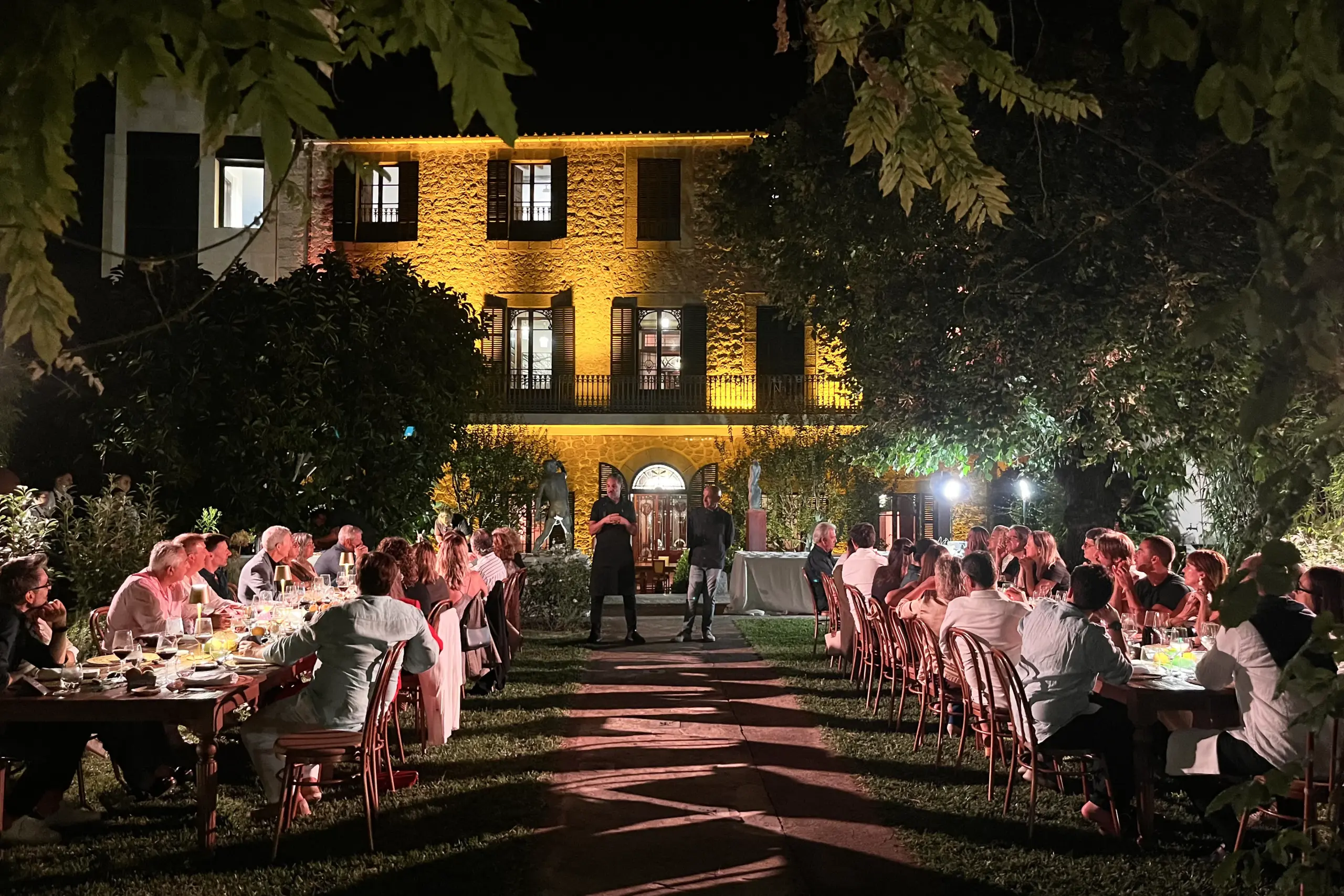
Tomeu Arbona and Santi Taura are revolutionizing the art of fine dining at Can Prunera
The Duke of La Rochefoucauld, Francis VI, wrote in his Maxims that eating is a necessity, but eating intelligently is an art. What would the venerable duke have thought upon seeing such a fusion of flavors, aromas, narratives, musicality, and delicious dishes parading through a Modernist house from 1911? Perhaps he would have summed it up with three simple yet nourishing words:
Savor, observe, taste, enjoy.
An equation that gently blends everything experienced and felt following the delicious culinary performance that took place last Saturday at Can Prunera. This Dionysian revelry was also characteristic of the era. Modernism bears an emblem, almost like a banner bearing a proclamation that urges us to embrace pure enjoyment; to surrender to that restrained ecstasy that is feasting with style and elegance. Arbona and Taura, archaeologists of taste, stimulated our senses from the very first second, making experimentation and fusion a creed without strict dogmas.
It all began at the historic gates of Can Prunera, where, more than 100 years ago, the Magraner Vicens family built a sanctuary where they could rest after a lifetime of work. They were seeking peace, yes, but also a place where everything they had enjoyed during their travels through Europe would come together—including the delights of fine dining.
The forty guests crossed the threshold and were greeted with a glass of Blanc 2025 wine from Microceller Son Crespí. Beside them, the paintings by Guillem Nadal and Ramon Canet watched intently, perhaps wishing—who knows—to be human for just once so they could savor every bite alongside us. This is where the eclectic adventure began. A few piano chords, masterfully played by Adrià Arbona of Papá Topo, welcomed us. Tomeu Arbona’s tenor voice energetically sang an old song, very similar to the glosses found in the Rondaies compiled by Antoni Maria Alcover. At his side, faithful squire, stood Santi Taura, shaping with his potter’s hands a piece that was created on the spot under the curious gaze of the attendees and the paintings of Joan Miró, ever-present at Can Prunera.
Both gave a brief historical introduction to what was about to take place on the three floors—the house’s old kitchen in the basement and the garden of the Modernist house—to kick off the feast. We were captivated by the intellectual thought process the two chefs had put into their work. They drew from the 1880 treatise El buen cocinero europeo (The Good European Cook) the recipe for cod à la Sollerense, since thousands of Soller residents emigrated to France during that period—just like the Magraners—and made their fortunes in the neighboring country. Like true Sóller natives, they left their mark wherever they went, including on the local cuisine, opening more than 43 restaurants in Marseille with people from Sóller at the helm of the kitchens. From the 18th-century Manuscrito de cuina de Can Olesa, they drew inspiration for the English-style steak with “mayordomo” sauce—an emulsion made with cow’s butter, parsley, salt, pepper, and lemon. A recipe of English origin, perfected according to French tradition and adapted to the stately setting of fin-de-siècle Sóller. Another deliciously sweet touch was provided by the famous “chocolate hour,” a tradition unique to Mallorca that took root in Sóller around 1870, as Archduke Lluís Salvador reminds us, writing that the town was home to more than 47 artisan chocolatiers—masters of the famous beverage—who specialized in making chocolate “a la piedra” (ground with a stone) and “a la taza” (served in a cup). All of this is always accompanied by the world-famous ensaimadas and potato cakes.
We must remember that an exclusive menu is not just a list of dishes; it is a visual poem that foreshadows a feast for the senses. Everything had an aura that was both aesthetic and practical, gracefully weaving together the evening’s experience. Rarely does one get to savor a tuna cocarroiet in front of a tapestry by Joan Miró, or a guinea fowl terrine from the Receptari de Can Torrella alongside works by Miquel Barceló or Joan Bennàssar. On very few occasions can one take a bite of a llampuga vegetable coca beside works by Juli Ramis, Francesca Martí, or Guinovart.
Arbona and Taura were masters of cuisine and life. Their canvas was Can Prunera. We, the diners, were the colors they needed to complete their work of art. As Rabelais wrote in his famous Gargantua and Pantagruel (1534):
And now, friends, let’s drink! Let’s eat!
Symbolizing, in the words of the newborn Gargantua, the joy, abundance, and vitalistic philosophy that these two Mallorcan artists instilled in us—creators of a new way of conceiving the art of cooking. They turned gastronomy into poetry. Poetry of the moment.