
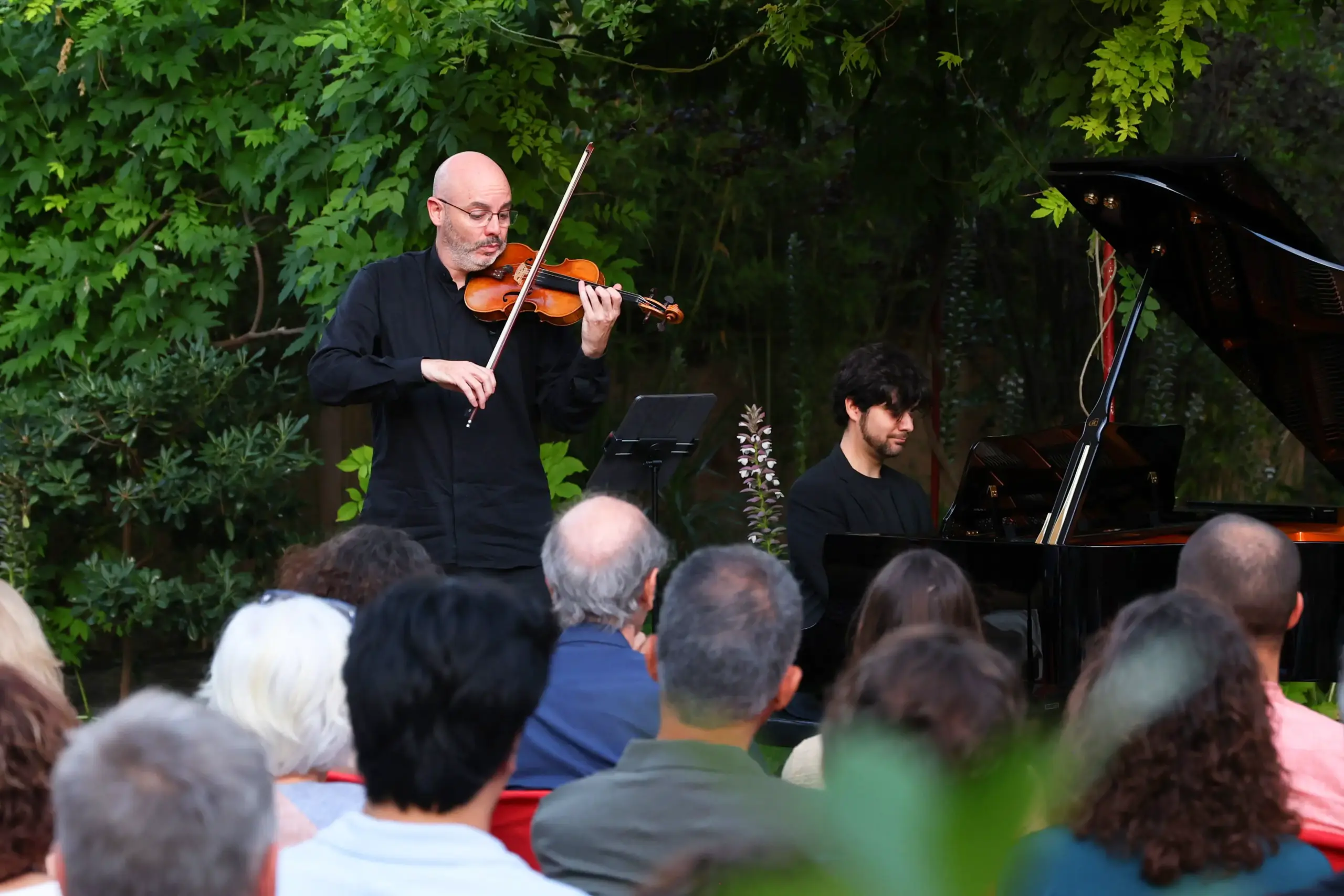
The rustling of leaves in the garden. A gentle breeze scented with jasmine. Ariadne’s four threads form the strings of Aitor Hevia’s violin. At his side, a loyal companion, Magí Garcías, caresses the piano. They converse, they whisper, they love. The mischievous swifts weave above them the eternal score of life. Few things are better than music. Over a hundred people were moved by the intimate polyphony offered by these two unique musicians, whose art transcends and whose souls move in perfect harmony.
Hevia and Magí, two contemporary romantics, lovingly selected the pieces they were to perform. As expert musicians, they know that the historical context of a place subtly influences the music that is played. It is not the same to play in an auditorium as it is in a garden, where the cooing of pigeons, the flight of swallows or the distant cries of a child can alter – or enhance – what is being performed. As always, Nature was that third musician on stage; a backdrop and a precise note that at times elevated the pieces by Clara Schumann, Robert Schumann and Johannes Brahms.
The nineteenth century is a reminiscence. Everything that happened seemed to possess that golden glow of glorious days gone by, and that sense of a bygone era also permeated the music. Existential complexity united the Schumanns with Brahms, the composer of noble music. The now elderly Robert Schumann, worn down by life, saw in the young Johannes the new Prometheus of music; the one who would breathe new life into the fading flame with a fresh wave of joy and good nostalgia. He was not mistaken in the slightest. For that reason, Hevia and Garcías chose to open the concert with a sonata for violin and piano by Brahms, composed between 1878 and 1879. Known as the ‘Rain Song’ Sonata, the atmosphere it creates is a kind of tempered, emotional and a spiritual refuge for the artistic triangle formed by Clara, Robert and Johannes. Magí and Aitor brought this immortal work back to life with great elegance, immersing us in the atmosphere of the 19th century.
The three romances by Clara Schumann, arguably the most important pianist of the 19th century, set the tone with sweeping elegance and delicacy, a tone the musicians would weave throughout the second half of the concert. After a brief interval, the music returned to the Garden of Can Prunera, which, as the months go by, is becoming a musical Arcadia. Intimate, multifunctional and refined, without unnecessary ostentation. Restraint is the yardstick, ensuring that elegance takes precedence over contrived eccentricity.
Robert Schumann’s Sonata for Violin and Piano in A minor, composed in 1851, brought the concert to a close, filling our ears with a delicate bouquet of sensations that ranged from the scent of fresh honey to the taste of the year’s first fig. This is yet another of the great powers of fine music: it has the ability to bring the seasons forward, to pause time and to make us daydream. This piece is pure romantic essence, as is Can Prunera itself, alternating playful waves of passion, sensitivity, Mediterranean fervour and a healthy sense of exhilaration that helps us carry on living. Violin and piano, Aitor and Magí, danced with time in the garden. And we danced with them.