
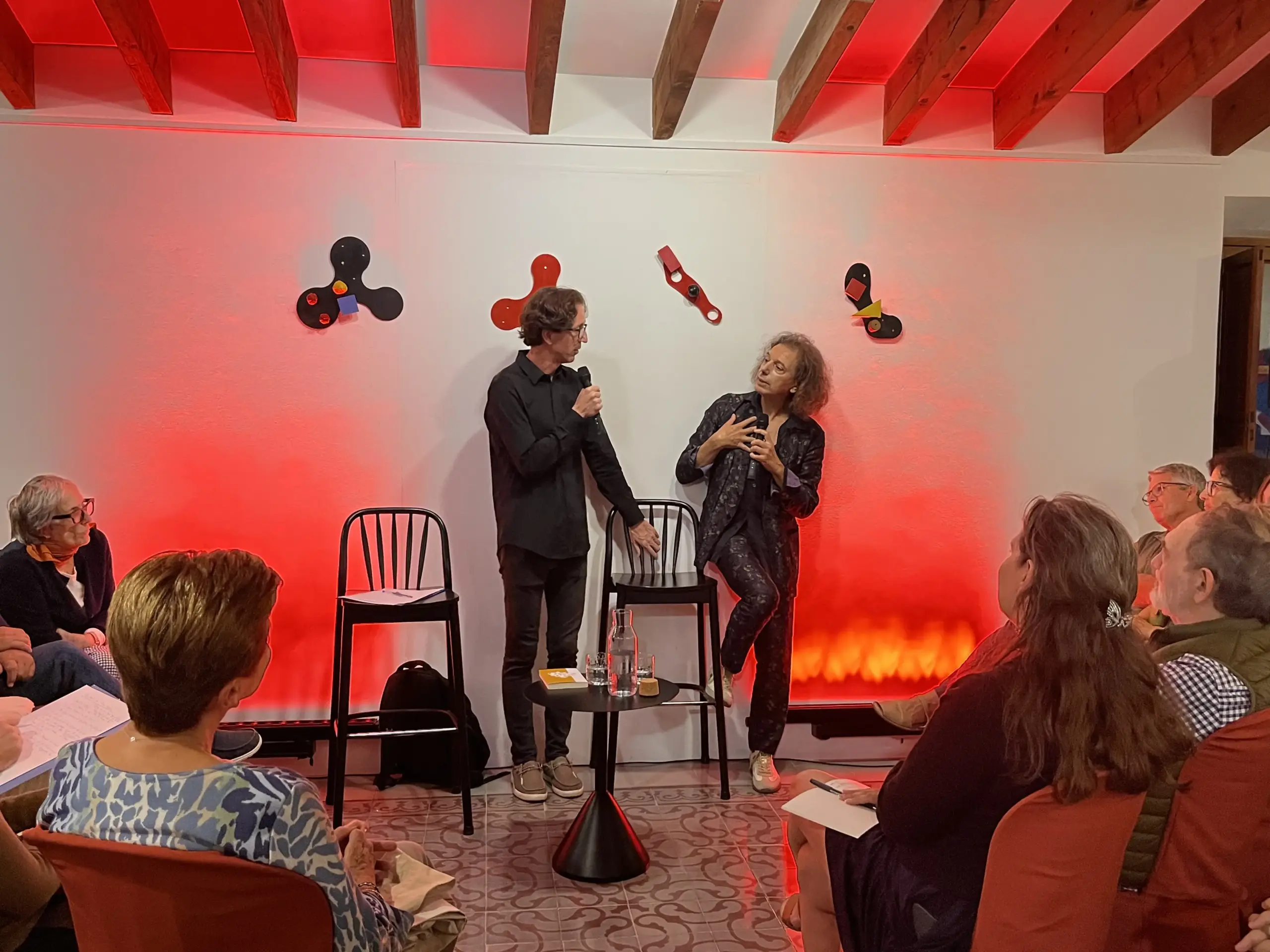
More than 100 people attended the French philosopher’s lecture series at Can Prunera on the impact of generative AI on the future of humanity.
For centuries, Horace’s Latin phrase, Sapere Aude––Dare to know—served as a beacon for humanism and culture. These two simple words challenged us to explore beyond ourselves and embark on the adventure of knowledge. In the act of thinking, creating, or experiencing beauty before a work of art, we elevated our human condition—always in the interplay of light and shadow––, yet destined for the infinite realms of the soul. With the disruptive arrival of generative AI, the famous “Sapere Aude” must be replaced by a resilient “Aude humanum esse”: dare to be human. Human fallibility, imperfection, fragility, or the warmth of touch will become basic necessities for affirming that we are still alive, occupying a specific place and time.
We are now witnessing the great anthropological shift of our time, Éric Sadin warns us. For the first time in human history, we are faced with a crossroads that Shakespeare already posed to us more than four centuries ago: to be or not to be, that is the question. The great classics of literature never lose their relevance, for they come back to life with every generation that reads them. In Hamlet, Shakespeare exposes a question that implies a struggle for that which defines us and consecrates us as brothers and sisters of all living things. Now, in the midst of the 21st century, if we choose to be, we will have to battle the hurricane of the technological imperative. If we choose not to be, we will witness the subrogation of our lives, and a bland non-existence will begin, directed by soulless digital entities. We will enter into the obsolescence of the human and wander aimlessly through the desert of our own selves.
Eric Sadin, with the power of his words, incisive thinking, and philosophical creativity, hit the nail on the head regarding the major problems plaguing us—problems magnified by the thoughtless use of generative AI. Backed by the brilliant Jaime Homar, who produced an excellent translation from French to Spanish, the conversation flowed like spring water. And it wasn’t easy at all. Professions like that of Jaime Homar—who is also a writer—are in mortal danger right now, which is why Sadin hits the sweet spot when he asserts that everything that requires time and training to produce a teacher, a translator, or a writer slows down the machinery of contemporary death. They give us a breather. In the face of the solipsism of the smartphone, the verses of Paul Valéry; in the face of the decline of reason, Calderón’s Life Is a Dream; in the face of insatiable greed, the salvific gaze of the other. The existential wealth that precedes us is vast and infinite. Sadin reminds us that we must not take our humanity for granted, because great sacrifices had to be made to achieve it.
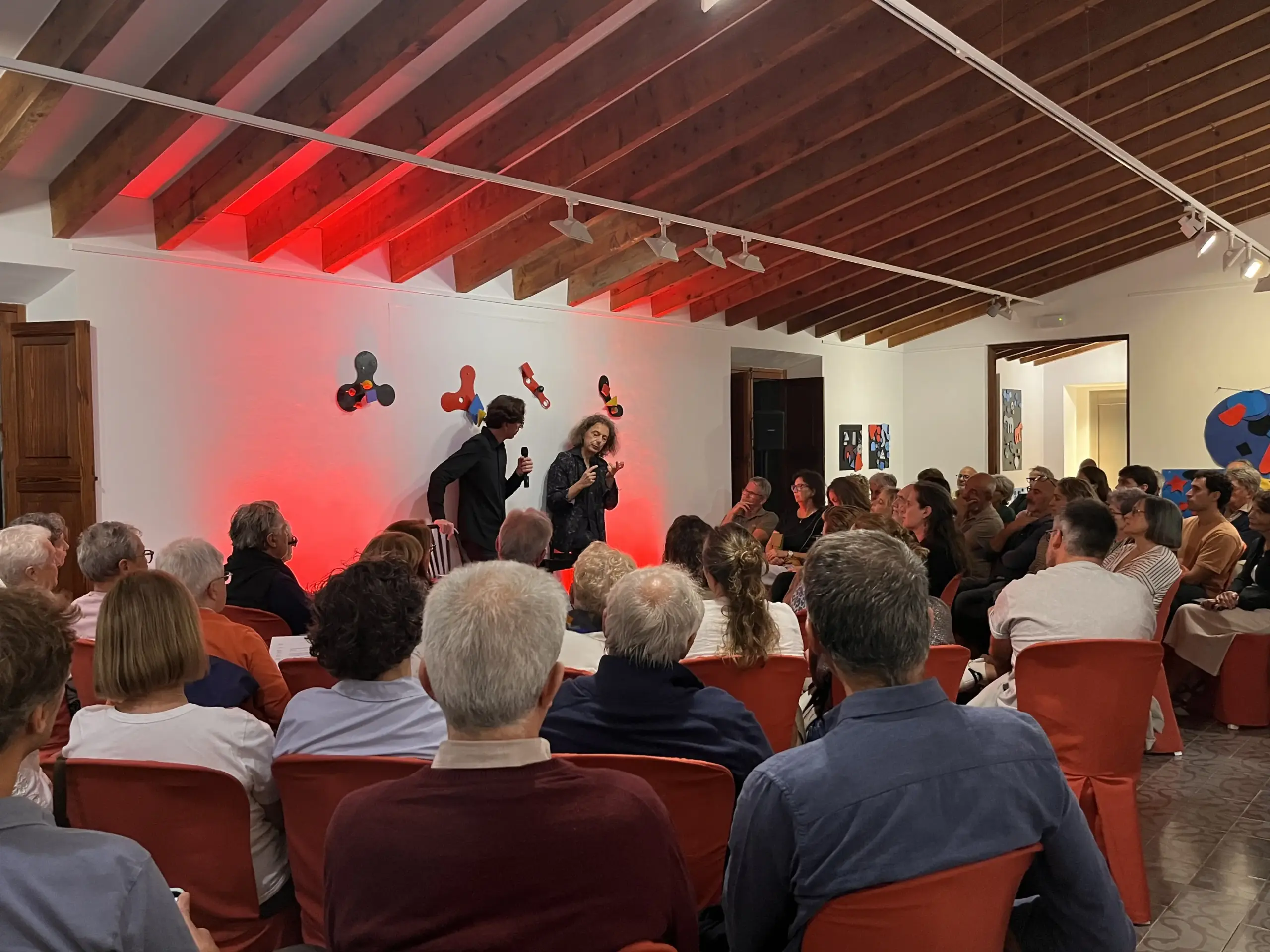
Sadin urges us to think critically and to take philosophical action. To this end, he draws on one of his key concepts: the “thanatologos,” perfectly articulated in his latest work, The Desert of Ourselves: The Intellectual and Creative Turn of Artificial Intelligence. The death of reason makes us small, almost laughable. Everything that stimulates our thinking and sets the gears of speech and language in motion is what defines us, and we cannot simply surrender it. Human beings, who are a direct complement to the time in which they live, will become a circumstantial complement. This loss of reason creates a rupture in today’s world, causing the very pillars of society to begin to crumble. At this point, we might ask ourselves: Will there be a metamorphosis into a digital homo ludens? Will we plunge headlong into a sterile existence guided by the false prophets of Silicon Valley? Will we chase the wisps that promise us unreal paradises while we watch life pass us by, helplessly?
Making assertions without providing arguments is immoral, says Sadin. We must ask ourselves the toughest questions to identify what we still have time to change or stop. For Eric Sadin, small acts of resistance are more necessary than ever. Poetry, art, writing, craftsmanship—in other words, whatever makes us pause in the face of what is not yet here—is humanism’s greatest weapon. The technological revolution will have to clash with the grandeur of the human condition. We will have to learn to say no in order to preserve ourselves.
Here, a literary symbol created by Herman Melville in his work Bartleby the Scrivener comes into play, with the unforgettable phrase: “I would prefer not to.” Like him, we should apply the “I would prefer not to” when Google assistants try to write our emails; when someone tells us we should use ChatGPT, refuse to use it; or when they try to convince us of how much time we’ll save by delegating our tasks to intelligent bots, respond with a resounding “I would prefer not to.”
Another of the key issues Sadin raised could be summed up in the following question: Why give AI that very human pleasure of creating something that doesn’t exist? Why give the joy of creation to an entity that neither enjoys nor creates? For several years now, a demiurgic harvest of data has been taking place. In today’s world, we produce, we do not create. Data accumulates on our phones, and we believe that who we are stems from content that doesn’t make us reflect, but rather makes us angry or leads us to denigrate others. Technology is a ventriloquist; it uses us. We must exercise extreme caution.
The important message Sadin brings to the table is that we must strive to reach 2030 as human beings and not as empty shells. The solution lies in the other—in regaining our ability to look into the eyes of our neighbors, face to face. Avoiding the hell of solipsism is now paramount. When an individual chooses to be a Narcissus-Pygmalion, in love with himself or his creations, that is when the desert draws near. Let us celebrate life, as Sadin reminds us by quoting Spinoza. Let us be the guardians of knowledge; let us defend life. If the desert within ourselves is approaching, it is our moral obligation to water the desert until the flowers of humanity bloom once more.