
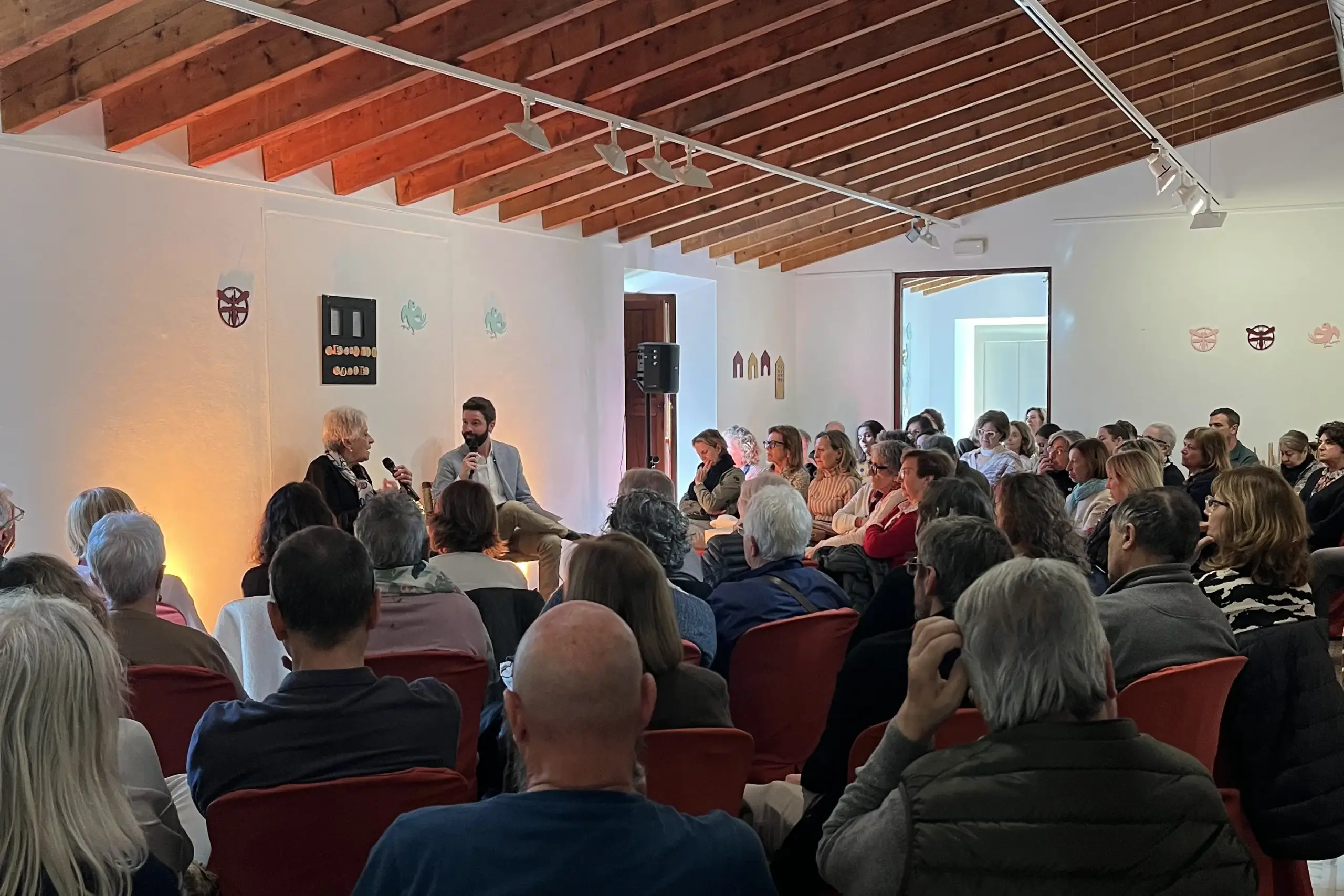
Last Friday, March 13th, ethics and morality regained their true meaning. Victoria Camps, a philosopher, writer, and leading thinker, united us under the banner of critical thinking and restored that light which, in our time, we sometimes forget even exists. Thanks to her new work, La Sociedad de la desconfianza, Camps charted a roadmap against nihilistic fatalism, pointing out what is wrong with society, but always through the prism of ethics and ethos, using them as both a magnifying glass and a telescope.
Like a tightrope walker, a balancing act, and a diviner of the human soul, Victoria identified the problems lying beneath the surface of contemporary life, but also everything that troubles us on a daily basis. The discontent of civilization, eternal dissatisfaction, the triumph of libertarianism, educational confusion, the hyper-bureaucratization of everything and everyone, excessive selfish solipsism, or the constant disinformation to which we are subjected. Faced with such a nightmarish panorama, Camps urges us to make room for the “we” of hope, for care, and for a truly humanistic philosophical stance to sustain life no matter what happens.
The hundred people attending the event were part of this enchantment that is created in spaces where one thinks. Silent attention to the gazes; young and old taking notes in notebooks so that Camps’ reflections would not fall into oblivion. And, above all, the collective feeling of being part of a unique moment of fellowship around the fire of philosophy to escape from indoctrination and unease. Victoria encouraged us to create a sort of Circle of Virtue, something similar to the Greek stoa, where we could meet periodically to philosophically converse and dialogue about the state of the world. Can Prunera is slowly becoming this center, space, and place where life converges to be thought about. Miquel Rullán, one of the directors of Can Prunera, reminded us in his beautiful introduction of the figure of the ambushed created by Ernst Jünger. But he added a subtle nuance. Perhaps we must ambush in the modernist house of Can Prunera, that is: To Cambushnera. Let’s make this neologism a possible way to be and exist in our time.
Before the event, we asked Victoria what the act of thinking meant to her. She answered wittily with a smile: An act? Thinking isn’t an act, it’s a habit. Rafael Argullol also reminded us that thinking is the reward and that if one makes thinking a habit, their existence will be fuller, perhaps even happier.